
GDPR / ISO 27001 Compliance for Startups and SMEs in Industry 4.0

The fourth industrial revolution has arrived in Pakistan’s startup ecosystem faster than the regulatory infrastructure built to govern it. Across Karachi, Lahore, and Islamabad, software houses are integrating AI into client workflows, fintech startups are processing the financial data of millions of users, and health-tech platforms are handling patient records at scale. Every one of these activities generates a compliance obligation — and for most Pakistani startups and SMEs, that obligation is invisible until the moment a European client, a bank partner, or an enterprise procurement team asks for proof.
That proof, in most cases, takes one of two forms: a GDPR-compliant data handling framework or an ISO/IEC 27001 certification. In the Industry 4.0 era, where machines, platforms, and supply chains are interconnected and data flows across borders in milliseconds, these are not bureaucratic formalities. They are the operating licence for any startup that wants to compete globally.
The problem has never been that Pakistani founders don’t understand the value. It is that the path to compliance has historically been built for companies ten times their size.
The Compliance Wall Every Growing Startup Hits
Pakistan’s IT and IT-enabled services exports hit a record $4.6 billion in FY2026, with the government targeting $15 billion by 2030. That ambition, however, runs directly into a structural obstacle most founders discover only when they are trying to close a deal: Pakistan holds no adequacy decision from the European Commission. Under GDPR, this means every European company sharing data with a Pakistani vendor must independently verify that the vendor’s security posture is adequate — through documented policies, evidence packs, and ideally a recognised certification.
For a startup with fifteen engineers and a pre-Series A runway, the traditional route to ISO 27001 — hiring a consultant, running a twelve-month implementation programme, paying certification body fees — can easily consume six figures in time and money. Many simply don’t try, and quietly lose contracts they never know they were competing for.
The same wall appears domestically. Pakistan’s Personal Data Protection Bill has cleared the federal cabinet, a National Commission for Personal Data Protection has been constituted, and penalties for serious violations are reported to reach $2 million. The compliance bar that once applied only to multinationals is descending rapidly toward every startup that collects, processes, or stores Pakistani citizens’ data.
A Pakistani Solution for a Pakistani Problem
Into this gap comes ComplyEncrypt, a Pakistan-built AI compliance platform that is repositioning certification not as a consulting project but as a product — something a team can do themselves, in weeks rather than quarters, at a fraction of the traditional cost.
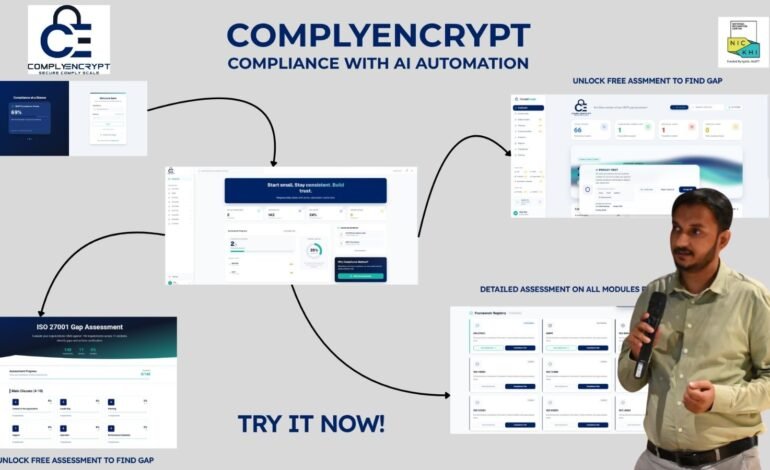
The platform offers ISO 27001 and EU GDPR compliance frameworks as one-time purchases, driven by an AI workflow that handles the parts of certification that have historically required a consultant on-site: gap analysis against the standard’s clause structure, drafting the policy library an auditor expects to see, mapping controls, scoring risk, and assembling the evidence pack. The stated goal is to take a startup or SME to approximately 90 percent of audit readiness in-house — leaving the final, nuanced risk decisions to an external auditor rather than eliminating the auditor altogether.
For founders navigating Industry 4.0, this distinction matters. The interconnected systems that define this era — IoT devices feeding cloud platforms, AI models trained on user data, APIs linking startups to banks and enterprise clients — each represent a data flow that must be mapped, a risk that must be assessed, and a control that must be evidenced. The question is whether a team of twenty engineers should spend months building that documentation from scratch or whether the scaffolding can be pre-built and the team’s attention directed to the decisions that actually require human judgment.
ComplyEncrypt’s answer is the latter. Its ISO 42001 artificial intelligence management systems module — aimed at startups building AI-powered products — is already in development, positioning the platform to address the next wave of compliance requirements before they become contractual demands.
Why Industry 4.0 Raises the Stakes
The compliance challenge that a previous generation of IT companies could defer is one that Industry 4.0 startups cannot. Consider the typical growth arc of a Pakistani SaaS startup today: it begins serving local clients, integrates a European payment processor to accept foreign revenue, takes on a German or Dutch enterprise client that requires a data processing agreement, and suddenly finds itself subject to GDPR Article 28 — which mandates that the processor implement technical and organisational measures adequate to protect the data it handles.
In Industry 4.0, the data involved is not just user emails and passwords. It is industrial sensor data, health metrics, financial transaction streams, and behavioural profiles. The volume and sensitivity have increased dramatically; so has the regulatory scrutiny applied to how it is handled.
Equally, the supplier risk assessments that enterprise clients now apply to their vendors have become more rigorous. A Pakistani startup bidding for a contract with a European manufacturer, a Gulf bank, or a multinational retailer will face a vendor questionnaire that effectively functions as a mini-audit. Without a documented information security management system — the foundation of ISO 27001 — that questionnaire cannot be answered, and the opportunity closes before a proposal is submitted.
As an industry veteran with around 15 years of experience and dozens of global certifications, I believe “The startups that will win globally in the next five years are the ones that treat compliance as infrastructure — built early, maintained continuously, and used as a competitive signal rather than a cost,”
“What ComplyEncrypt does is make that infrastructure accessible to a ten to twenty-person team in Lahore on the same terms it has always been available to a two-hundred-person firm in London. That is the gap we are closing.”
What the Platform Actually Does
For a startup encountering ISO 27001 for the first time, the standard can appear impenetrable: 93 controls across 11 control domains, a risk assessment methodology, a Statement of Applicability, a policy library running to dozens of documents, and an internal audit cycle that must be maintained after certification is achieved.
ComplyEncrypt breaks this down into a guided workflow. The gap analysis identifies which controls apply to the organisation’s specific context — a SaaS company handling personal data has a different risk profile from an IoT hardware manufacturer — and prioritises the remediation effort accordingly. The policy library is generated against the organisation’s actual data flows and vendor relationships rather than from generic templates, which is the point at which most DIY compliance attempts fail under audit scrutiny. Evidence collection, which in traditional implementations means a compliance officer manually gathering screenshots and access logs, is systematised and continuous.
For GDPR specifically, the platform addresses the obligations that catch Pakistani startups off guard: the record of processing activities required under Article 30, the data processing agreements required under Article 28 when acting as a processor for a European controller, and the incident response procedure that must support the controller’s 72-hour breach notification window.
The result, the company says, is that certification stops being a project that competes with building the product and becomes a workflow that runs alongside it.
The Bigger Picture
Pakistan’s startup ecosystem is at an inflection point. The infrastructure is being built — the PDPB, the SBP’s regulatory sandbox for fintech, the GSP+ framework for exporters — but the compliance capacity to operate within it is not keeping pace. Every framework that opens a door simultaneously raises the documentation required to walk through it.
For the generation of Pakistani startups scaling in the Industry 4.0 era, that documentation is not optional. The clients they are trying to serve, the investors they are trying to attract, and the regulators they are now subject to all require the same thing: verifiable evidence that the organisation handles data with discipline and that it has the systems in place to sustain that discipline over time.
The question is not whether Pakistani startups need to get there. It is how quickly and at what cost.
About ComplyEncrypt
ComplyEncrypt is a Pakistan-built AI compliance platform offering ISO 27001 and EU GDPR certification frameworks on a one-time purchase basis. Designed for startups and SMEs, the platform guides organisations through gap analysis, policy drafting, risk scoring, and audit evidence assembly, targeting approximately 90 percent of audit readiness in-house. ISO 9001, 14001, 45001, and ISO 42001 (AI management systems) frameworks are on the product roadmap. Further information is available at www.complyencrypt.com.
By S.M. Waqas Imam| Founder, ComplyEncrypt | Industrial Engineer & IRCA CQI-Certified Lead Auditor (ISO 27001, ISO 9001, ISO 14001, ISO 45001, ISO 13485 etc.) | Management Systems Consultant with 15 Years of Experience | Instructor to 2M+ Learners on Udemy & Other Free Online Platforms